
Stablecoins, AI and the shape of treasury to come

Corporate treasurers in Africa navigate FX volatility, limited hedging tools, and trapped cash through match funding, contract structuring, and local expertise.
Treasury’s interest in stablecoins and AI is often grouped together under the same broad banner of innovation. Yet the two technologies address very different needs. One is focused on the movement of value — faster, more flexible and less constrained by traditional payment infrastructure. The other is changing how treasury teams analyse information, redesign workflows and make decisions.
That distinction came through clearly in remarks from Kathy Brustad, Treasury at Microsoft, and Kammy Tsang, senior director, head of global cash management at PayPal at the 11th EuroFinance Treasury & Cash Management Summit West Coast. Tsang focused on the growing relevance of stablecoins to treasury operations, while Brustad outlined how AI is already changing the way treasury teams work with data, automation and risk. Together, their comments pointed to a function that is being pushed to rethink both execution and intelligence.
Stablecoins are gaining momentum, but corporate treasury is still at an early stage
Tsang made clear that most treasurers are still in the early stages of thinking about stablecoins. Referring to audience polling that showed most firms had not yet started their stablecoin journey, she said this remained “pretty standard in corporate America”.
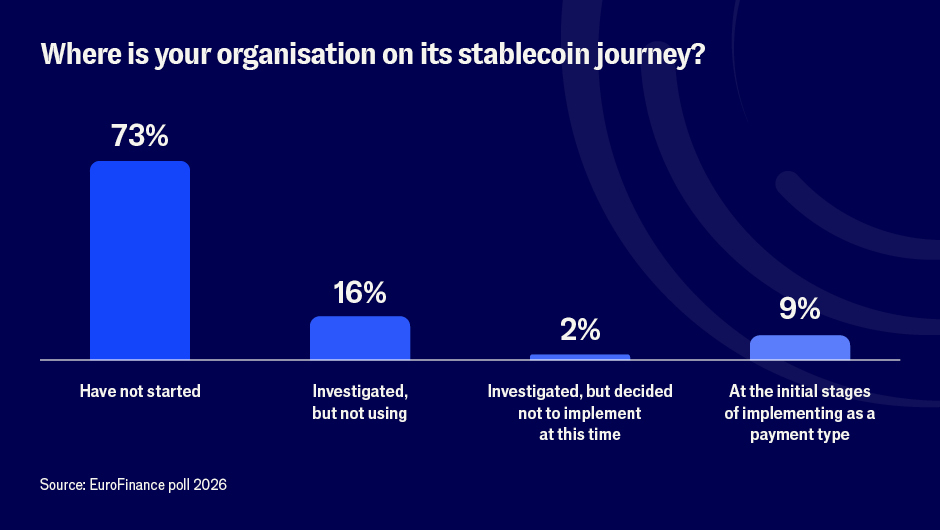
She described stablecoin as “a digital asset pegged to a stable value”, whether that is the US dollar, the euro or “a basket of stable assets”. At the same time, she stressed that “not all stablecoin are the same”, underlining the need for treasury teams to distinguish carefully between different instruments and structures.
In Tsang’s view, the market backdrop has changed significantly since early 2024. She pointed to four developments in particular: growth in market capitalisation, a shifting regulatory environment, and stronger engagement from banking partners and rising corporate interest. She noted that stablecoins market has doubled since early 2024. She also observed that “83% is dominated by USDT (Tether) and USDC (USD Coin)”.
Regulation, she suggested, has been one of the key drivers behind the change in tone. Referring to the GENIUS Act, Tsang said it had created a clearer regulatory framework and altered the landscape for corporates considering stablecoin. As a result, the conversation has shifted. “This year the dialogue is very different,” she said. “How can I establish it? What are the steps we need to take? How can I actually do it?”
Where stablecoins may fit
Tsang said PayPal is already using stablecoin across several parts of its organisation, including merchant services, consumer-related payment activity, treasury and business-to-business payments.
The treasury use case was one of the most concrete examples discussed. “We did a proof of concept and real-time use case to settle intercompany across 3 continents, last year exceeding a billion,” she said. For multinational treasury teams managing intercompany settlement across time zones and cut-off windows, the benefit was clear: the company was able to complete the work with a small team “under a few hours”, with the process moving closer to real time.
Tsang described the attraction of stablecoin in practical terms: it is “24/7, not subject to banking hour, instantaneous, and also the speed and low cost”. But she did not present it as a substitute for traditional money. “I don’t see stablecoin replacing our traditional fiat anytime soon,” she said, describing it instead as “another parallel”. More importantly, she argued that stablecoin should not be seen simply as another payment option. “It’s a lot more than an alternative payment method,” she said. “It’s a totally new financial instrument.”
Scale, access and usability
Brustad approached AI from a different perspective. Rather than presenting it as entirely new, she described it as an extension of longstanding developments in machine learning and data science. “AI is a set of technologies,” she said. “It’s still learning from data. It’s still making predictions out of the data.”
What has changed, she argued, is the scale and range of what these systems can now process. “The only change from a couple of years ago is really that the ability to process or learn from the type of data, the amount of data to learn from is much, much bigger in a much more massive scale,” she said. “You don’t have to put your data in rows and columns.” She added that the ability to learn from “any type of data, any structure of data, even code” has created “an elevated level of accessibility”.
On regulation, Brustad said it had not altered Microsoft’s overall direction, but it had helped the company build a stronger governance framework. She described the importance of defining “what’s sensitive use, what’s restricted use, and how we should think about governing AI, in treasury, that question is closely tied to accountability.”
The bigger prize is process redesign
Brustad noted that AI matters less as a tool for automating existing work than as a catalyst for rethinking how treasury operates. “It really is about — not even about AI, it’s about forcing us to look inward at all of our core business processes and say, where are the bottlenecks? Where are the pain points? Where are the added complexities?” she said.
That is why, in her view, process redesign has to come before automation. “You must have a broken process. Don’t automate a broken process,” she said. Treasury teams need to identify the points of friction, determine what can be removed and clarify what remains non-negotiable from a compliance or control perspective.
She gave several examples from Microsoft Treasury. In one case, a team member built an agent to handle end-of-day balance reconciliation, using AI to open PDFs and emails, identify balances and format the information appropriately. Brustad also cited measurable gains from wider treasury applications, saying Microsoft had saved “312,000 hours with our intelligent collection solution last year” and “64,000 hours” in its credit review process. Those results, she said, were only possible to demonstrate because the team had established baseline metrics and tracked outcomes carefully.
Extending treasury’s foresight
Brustad also described a use case that goes beyond workflow efficiency and into risk visibility. She said Microsoft had built an AI application to scan breaking news around the world while also drawing on company-specific information, including where the business operates, where it holds bank accounts and where it has currency exposures. The aim is to determine if a development matters to treasury and what action is needed
As Brustad put it, the system is able to identify when “this news is applicable to you” because it can connect external developments to internal exposures and explain the reasoning behind that assessment. She contrasted that with the limits of manual monitoring. “No human has the capability to scan every piece of news around the world to find out, is this applicable to me?” she said. “But now with AI, it can do it for you.”
The real issue is trust
Although stablecoins and AI solve different problems, both speakers returned repeatedly to questions of risk, oversight and trust.
For Tsang, stablecoin adoption begins with a risk assessment. She said PayPal looks at “three types of risk: operational risk, liquidity risk, and counterparty risk”. Treasury teams need to understand what happens if systems fail, how backing and liquidity work, and who the relevant partners are. “It starts with risk assessment,” she said.
For Brustad, the equivalent challenge in AI is whether treasury teams can rely on the output. “When people talk about the reliability of the models, what they’re really asking is, can I trust what this AI gave me?” she said. Her answer was that trust depends on governance, guardrails, evaluation loops and continuous monitoring instead of a single implementation.
She also described how Microsoft sees AI as operational: “we view AI as our digital colleagues”. But that does not remove human accountability. The progression, she said, runs from “human-assisted by AI” to “human-led and AI-operated” and ultimately to “AI executed with human oversight”.
Combining foresight and execution
When the discussion turned to how the two technologies might eventually work together, Brustad offered perhaps the clearest summary: “AI is the foresight and stablecoin is the speed.” In her framing, AI provides forecasting, prediction and recommended action, while stablecoin provides an execution layer built for speed. “AI sort of directs and stablecoin executes,” she said, pointing to the possibility of treasury operations that become increasingly autonomous and real time, while remaining under human oversight.
Tsang agreed that the two could eventually complement one another, pointing to the programmability of stablecoin and the possibility of linking actions and triggers within a governed framework. But her broader point was that treasury teams need to move beyond theory. “You can’t learn how to swim with a book,” she said. “You need to test it.”
Taken together, their comments suggest that stablecoins and AI are entering treasury on different tracks, but with a similar implication. Treasury is being asked to move from observation to experimentation. Whether the focus is settlement, forecasting, risk visibility or process redesign, the challenge is to determine where these technologies can change how treasury operates.