
Treasury priorities live from EuroFinance Treasury & Cash Management Summit West Coast

Artificial intelligence is emerging as the top technology priority for corporate treasury teams, while stablecoins and digital currencies remain largely in the exploration phase, according to discussions at the EuroFinance Treasury & Cash Management Summit West Coast.
New technologies are increasingly shaping discussions within corporate treasury. Artificial intelligence, digital currencies and automation are moving into focus, while firms continue to invest in systems, liquidity management and skills. Recent policy around stablecoins—particularly proposals in the United States like the GENIUS Act, which aims to establish a regulatory framework for stablecoin issuers—have also pushed digital currencies further into the mainstream financial conversation.
Live audience polling at the 11th EuroFinance Annual Treasury & Cash Management Summit West Coast shows how organisations are responding. The results suggest that while new technologies are widely discussed, adoption levels vary. Stablecoins and digital currencies are still being explored, while artificial intelligence is already finding practical uses inside treasury teams.
Stablecoins remain largely exploratory
Despite growing attention from policymakers, stablecoins remain largely unexplored in corporate treasury.
73% of respondents said they have not started to explore stablecoins. A further 16% said they have investigated stablecoins but are not using them, while 2% said they explored the technology but decided not to implement it at this stage.
9% said they are in the initial stages of implementing stablecoins as a payment type.
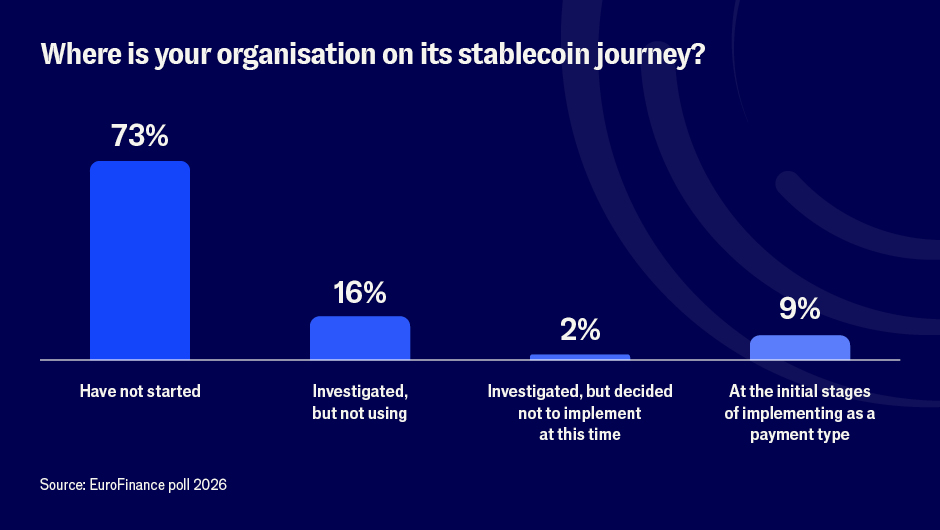
These responses suggest that while regulatory developments and market discussions are bringing stablecoins into focus, most treasury teams are still observing developments rather than taking immediate action.
Digital currencies mostly in monitoring phase
The broader use of blockchain and digital currencies in treasury shows a similar pattern.
39% of respondents said the technology is not currently on their organisation’s radar, while 39% said they are monitoring or learning about it.
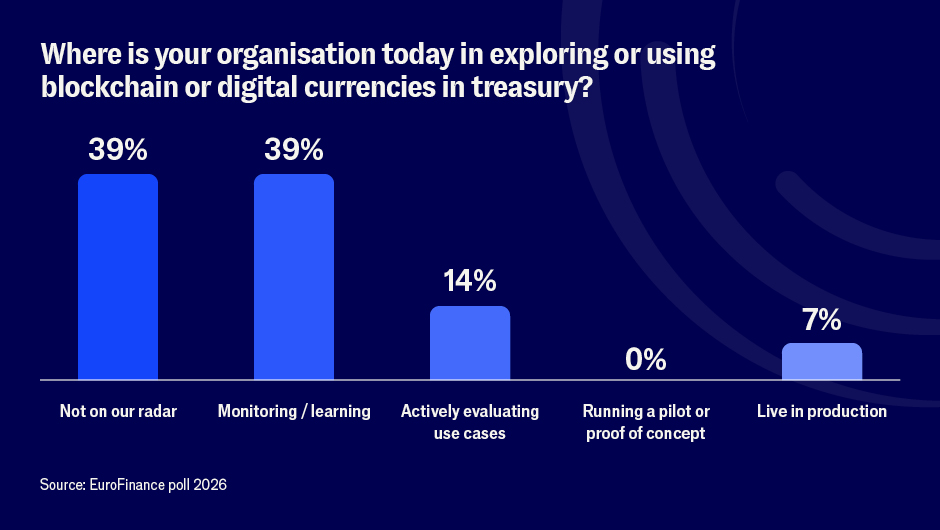
14% said they are actively evaluating use cases, while 7% reported that blockchain or digital currency solutions are already live in production. Notably, none of the respondents said they are currently running a pilot or proof of concept.
Overall, the results show a technology that is widely discussed but still at an early stage of practical use within treasury operations.
AI becomes part of everyday treasury work
Artificial intelligence presents a different picture. Unlike stablecoins or blockchain, AI is already being used by many treasury teams—often in simple ways.
Polling shows that 57% of respondents use AI for support tasks such as emails, presentations and general queries. Another 21% said they are currently identifying potential treasury use cases, indicating that many organisations are still exploring how the technology can support more specialised functions.
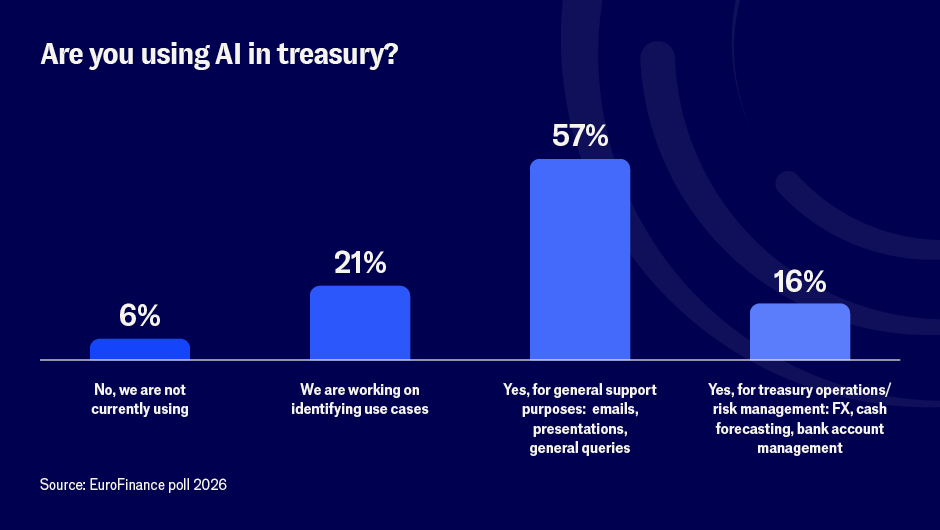
A smaller share has already integrated AI into operational processes. 16% said AI is used in treasury operations or risk management, including FX, cash forecasting and bank account management, while 6% said they are not currently using AI at all.
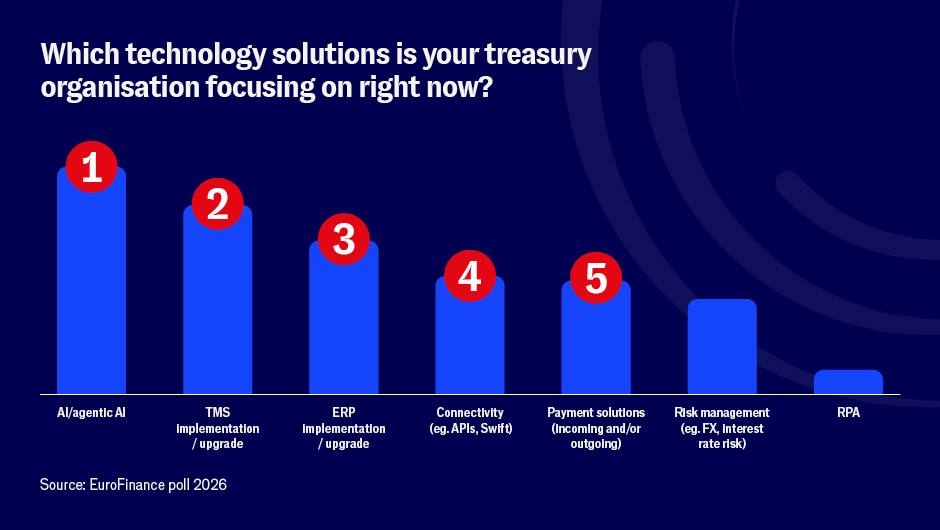
AI leads the list of treasury technology priorities. When respondents ranked the technologies their organisations are currently focusing on, AI or agentic AI came out on top, followed by treasury management system (TMS) implementation or upgrades and ERP implementation or upgrades.
Connectivity solutions such as APIs or SWIFT ranked next, followed by payment solutions and risk management technologies. Robotic process automation (RPA) ranked last among the options.
AI expected to drive future change
Looking ahead, treasury professionals expect artificial intelligence to play an even larger role. When asked which factor would most transform treasury teams over the next five years, 80% selected AI and predictive analytics, while 20% selected real-time data and APIs.
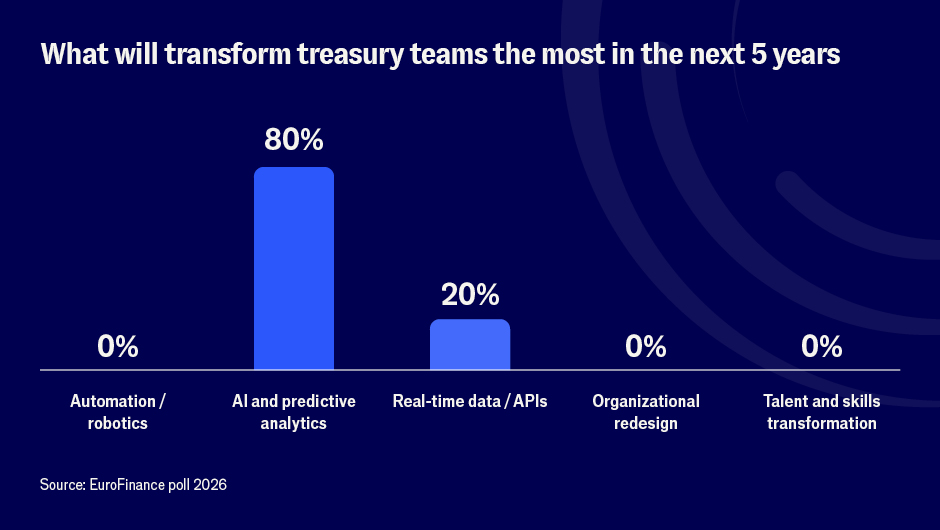
The results reinforce the view that AI is likely to remain at the centre of technology discussions within treasury in the coming years.
Adoption still faces practical barriers
Despite growing interest in AI, implementation is not without challenges.
The most frequently cited barrier was bandwidth or competing priorities (29%), suggesting that many teams are balancing AI projects alongside other initiatives. Integration with existing systems followed closely at 28%.
Other obstacles included data challenges (18%), team or IT partner knowledge (16%), and budget constraints (5%). Smaller shares pointed to leadership priorities (3%), stakeholder engagement (1%), and working through an AI strategy (0%).
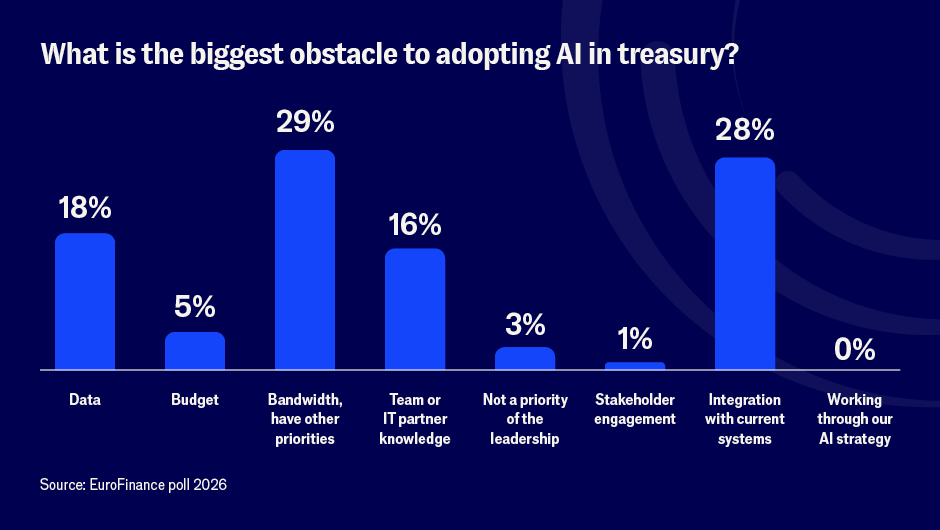
These responses indicate that while the technology itself is advancing quickly, adoption within treasury still depends on organisational capacity and system readiness.
Automation remains a work in progress
Alongside AI adoption, treasury teams continue to work on broader automation efforts.
47% of respondents said they are working on automation but still have a long way to go, while 27% said they are about halfway to their target level.
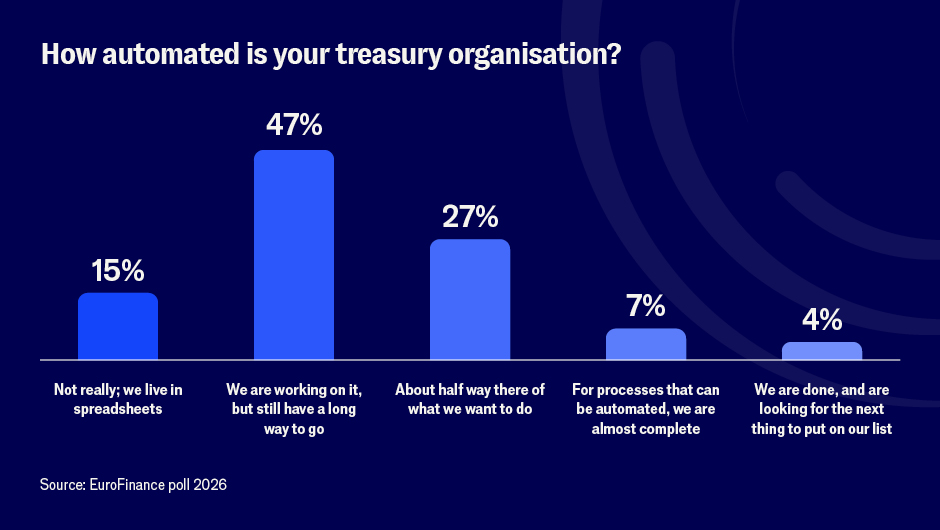
At the same time, 15% said they still largely operate in spreadsheets, reflecting the continued presence of manual processes in some treasury functions. By contrast, 7% said automation is almost complete for processes that can be automated, and 4% said automation is largely complete and they are now looking for the next initiative.
Most firms describe themselves as followers
When asked about their organisation’s position in the technology adoption cycle, most respondents placed their firms in the middle of the curve.
42% described their organisations as fast followers, while 39% said they are slow followers or late adopters. 19% said they see themselves as first movers or innovators.
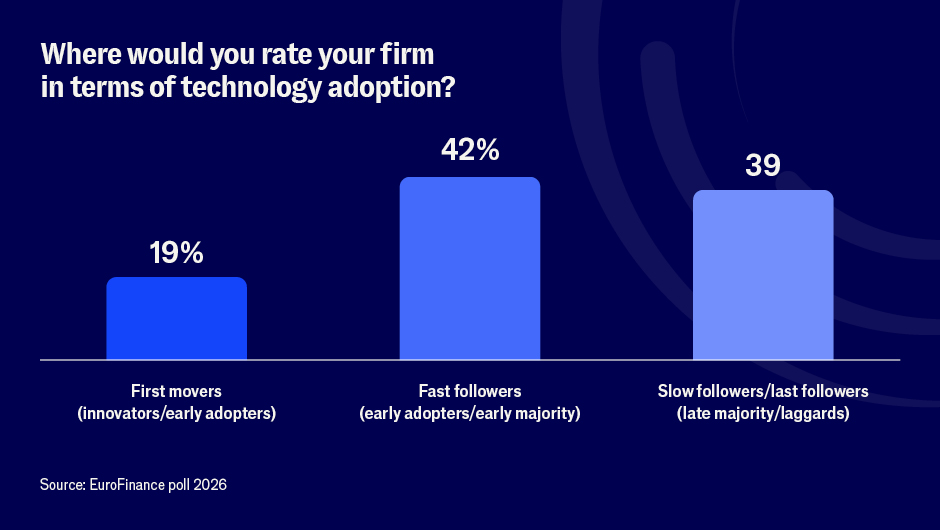
This distribution suggests that many treasury teams prefer to adopt new technologies once they are more established.
AI leads current treasury priorities
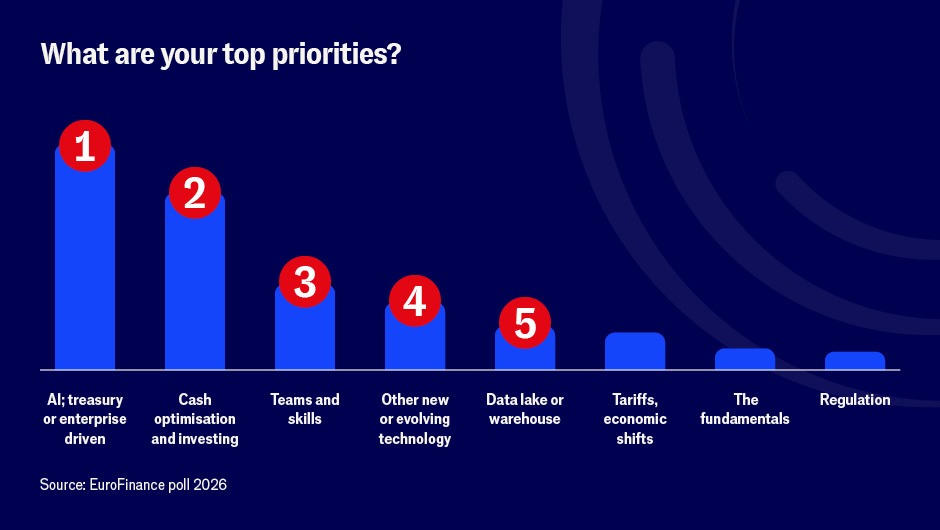
When respondents ranked their top three priorities, AI—whether treasury-driven or enterprise-driven—ranked highest.
This was followed by cash optimisation and investing, reflecting treasury’s continuing focus on liquidity and capital efficiency. Other priorities included teams and skills and other new or evolving technology.
Further down the list were data lake or warehouse initiatives and tariffs and economic shifts, while the fundamentals and regulation ranked lower.
Liquidity remains the main capital focus
Despite the growing focus on technology, balance-sheet priorities remain central.
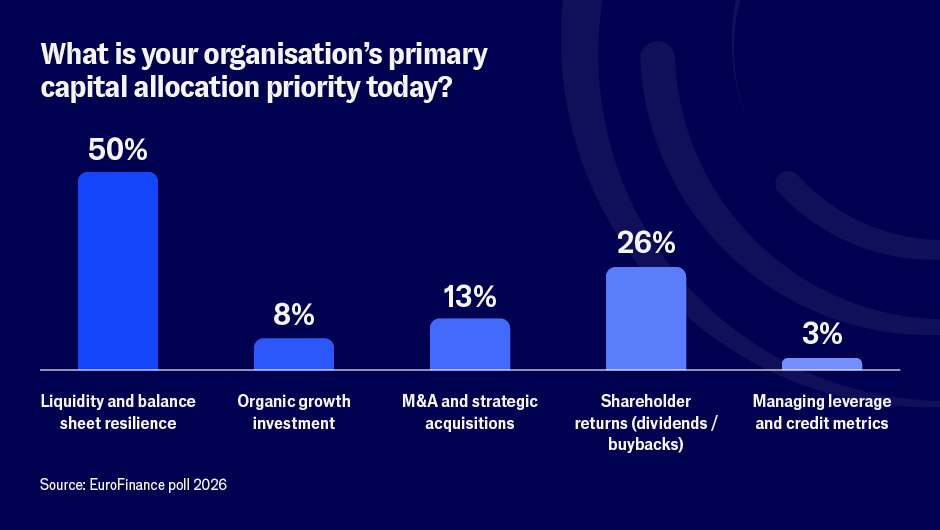
50% of respondents said liquidity and balance-sheet resilience is their organisation’s main capital allocation priority. 26% selected shareholder returns such as dividends or buybacks, while 13% pointed to M&A and strategic acquisitions.
A smaller share prioritised organic growth investment (8%), while 3% said managing leverage and credit metrics.
Skills gaps reflect changing treasury needs
As treasury becomes more data-driven and technology-focused, capability gaps are also evolving.
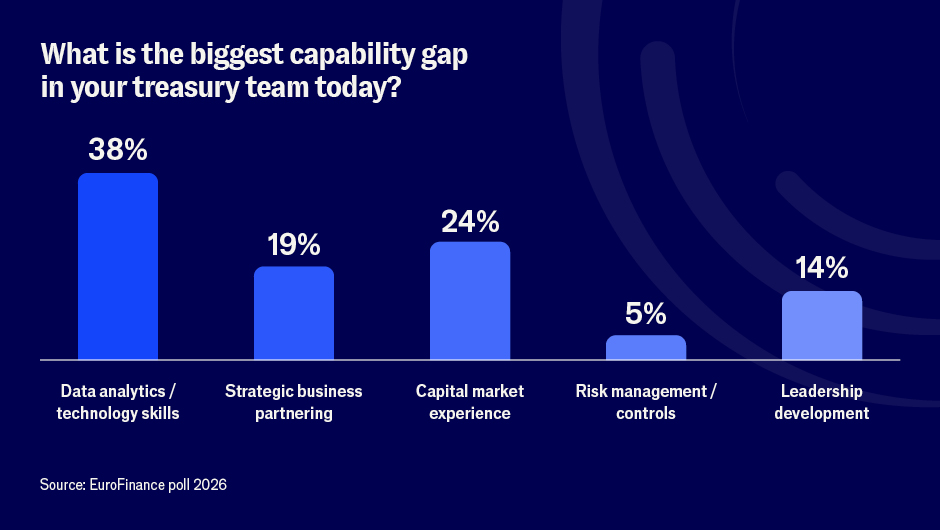
Data analytics and technology skills were cited most frequently, at 38%. This was followed by capital markets experience (24%) and strategic business partnering (19%).
Other areas included leadership development (14%) and risk management and controls (5%).
Taken together, the polling results highlight a treasury function balancing technological change with traditional priorities. Artificial intelligence is already becoming part of everyday work, while stablecoins and digital currencies remain areas most organisations are still watching as regulatory frameworks and practical use cases continue to develop.